Enterprise SaaS · 2026
AI Agent Sales Flow
Replacing manual CPQ and approval handoffs with agentic automation - from offer configuration to signed agreement in a single, connected workflow.
Enterprise SaaS · 2026
Replacing manual CPQ and approval handoffs with agentic automation - from offer configuration to signed agreement in a single, connected workflow.
Timeline
Q1 2026
Team
Product design, engineering, QA
My Role
End-to-end product design
Platform
Web - Enterprise SaaS
A B2B telecom customer wants to relocate their primary office from Cologne to Bonn. What sounds like an address change is actually a weeks-long process spanning a dozen teams, tools, and approval gates. I redesigned it as a single AI-assisted screen.
When a large B2B customer wants to modify their connectivity agreement - relocating an office, adding new sites, upgrading bandwidth - a sales rep had to coordinate across disconnected systems. Configure new offers and terminate old ones. Verify serviceability at the new location. Price the change. Model the P&L impact. Get internal approval. Obtain customer sign-off.
Each step lived in a different tool or required a handoff to a different team. The result: long cycle times, configuration errors from manual re-entry, and reps spending more time navigating systems than working with customers.
The design question wasn't "how do we add AI to the sales process?" It was "which parts of this process should never require a human in the first place?"
This project covered the full end-to-end workflow - not a single screen, but an entire quote amendment experience. Each component required its own design logic:
The offer configuration interface where reps add, modify, and terminate service lines. Designed to surface AI suggestions contextually - at the moment a rep is reviewing a specific offer, not as a separate recommendation feed.
A live feed of everything the AI agents are doing in the background - serviceability checks, service allocation, dependency validation. Designed to be a trust layer, not a log: curated, labeled, and readable at a glance.
Financial reporting embedded directly in the quote screen. I designed the report structure, the AI-generated executive summary panel, and the natural language Q&A interface that lets reps ask questions about margin, NPV, and cash flow without leaving the workflow.
Contextual AI interventions that surface during the workflow - not as a separate assistant, but as a panel that appears when the agent detects a decision point. The rep sees the context, the options, and the impact before acting.
The offer configuration view is where the rep builds the amendment. As they work, AI agents run in parallel - verifying serviceability, checking service dependencies, validating configuration rules. All of this is surfaced in the Activity Log: a persistent side panel that shows every agent action as it completes, labeled with its step and outcome.
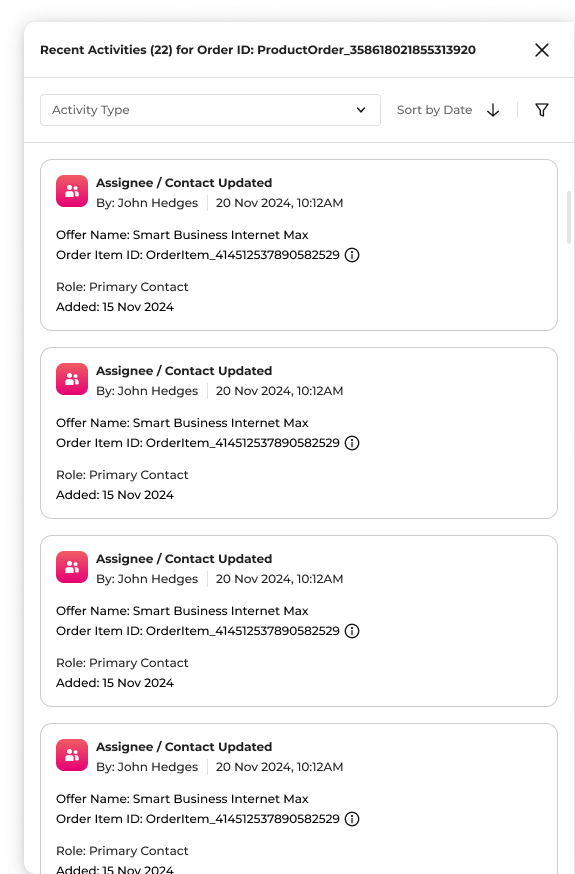
The original system had an activity log - but it was a generic audit trail: a drawer that listed every system event in chronological order with no hierarchy, no grouping, and no indication of what anything meant for the deal. Every entry looked identical. Nothing was actionable.
The redesigned Activity Log is the opposite: a curated, real-time summary organized by agent and step. Each entry is labeled with what ran, what it found, and whether it cleared. Reps can see at a glance that serviceability has been verified, dependencies are clean, and the quote is ready to price - without opening a single sub-screen.
Before
After
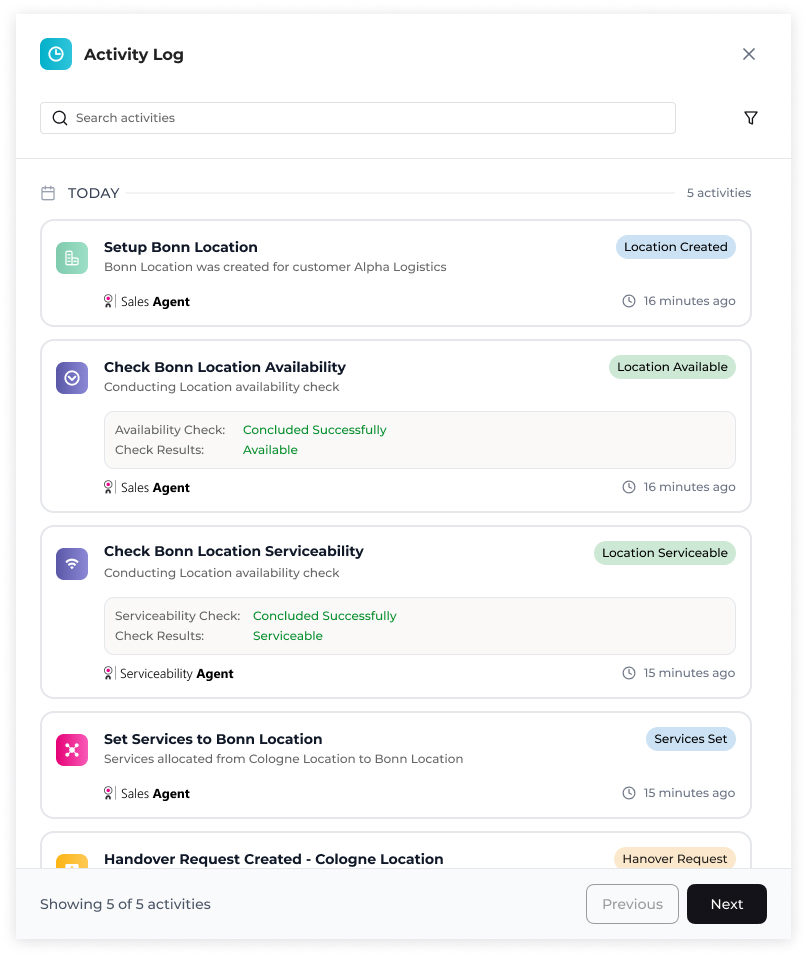
Left: a drawer full of identical entries. Right: a structured, agent-organized log that tells the rep exactly where the process stands.
While the rep is configuring the amendment, the AI agent monitors the deal in real time and surfaces decision points as they emerge. Not a chatbot, not a dashboard widget - a focused intervention that appears when there is something specific to decide.
In this case: the customer is requesting to waive an overlap cost of €273, which falls below the rep's approved discount threshold of €500. The agent detects this, surfaces the context, and offers two concrete paths - waive the full amount and notify the customer, or enter a custom waiver amount. The rep decides. The agent acts.
The design principle: the agent has enough context to know what the decision is, but not enough authority to make it. The panel exists precisely at that boundary.
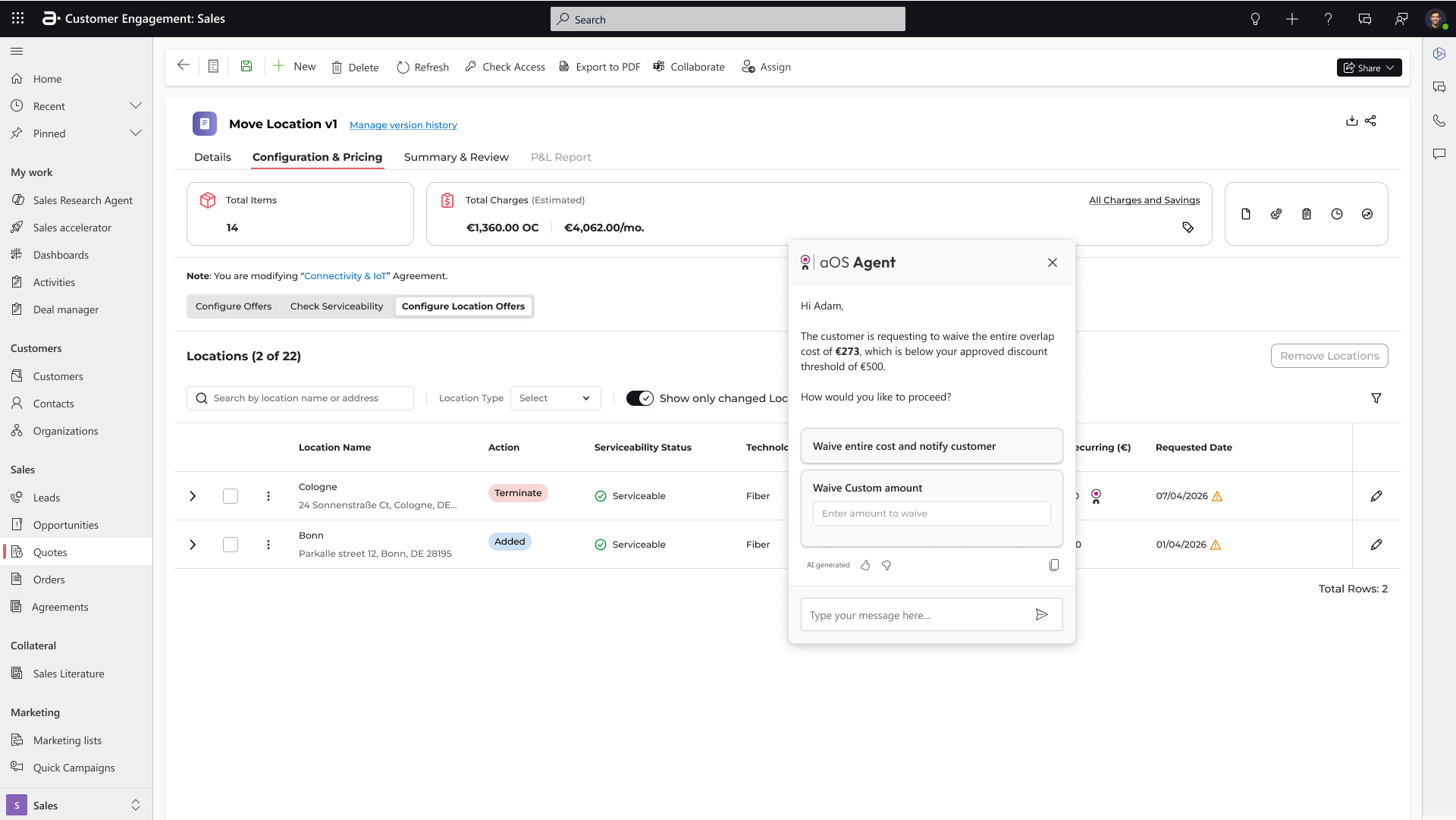
The aOS Agent appearing mid-flow with a specific, actionable suggestion. Context surfaced, options presented, decision left to the rep.
Before the redesign, the P&L report was a dense data dump - a 200-row spreadsheet-style table that finance teams understood and nobody else did. Sales reps would submit a quote, wait for finance to run the numbers, then adjust. Days lost per deal, every deal.
The redesign started from a single question: what does a rep actually need to know to make a pricing decision? Not every row - the signal. Gross margin, NPV, cash flow curve, and whether the deal clears the threshold. Everything else can live below the fold.
The insight from research: reps weren't avoiding the P&L because they didn't care about margin. They were avoiding it because the report didn't speak to them. The redesign is a translation layer, not a simplification.
Before
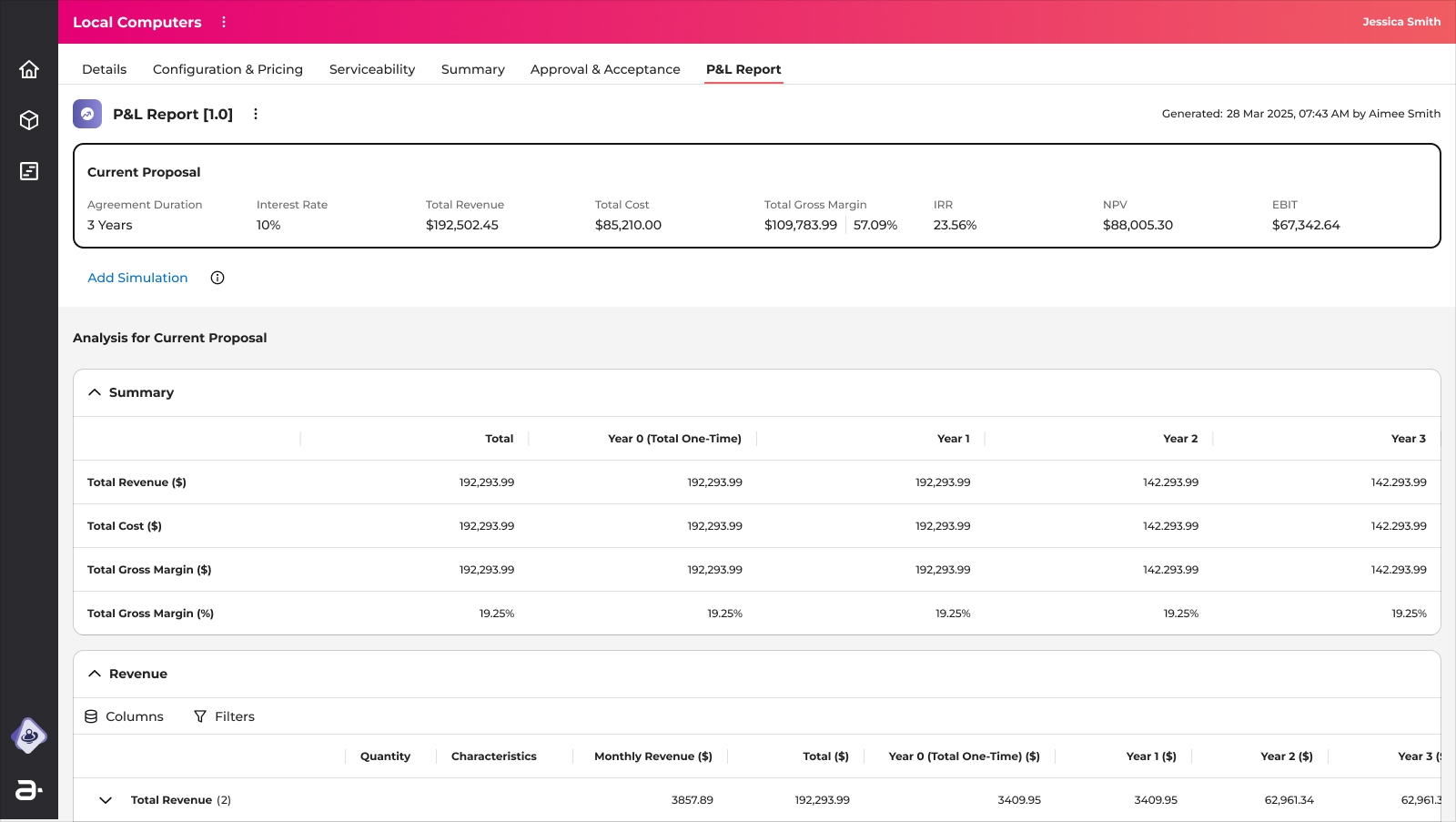
After
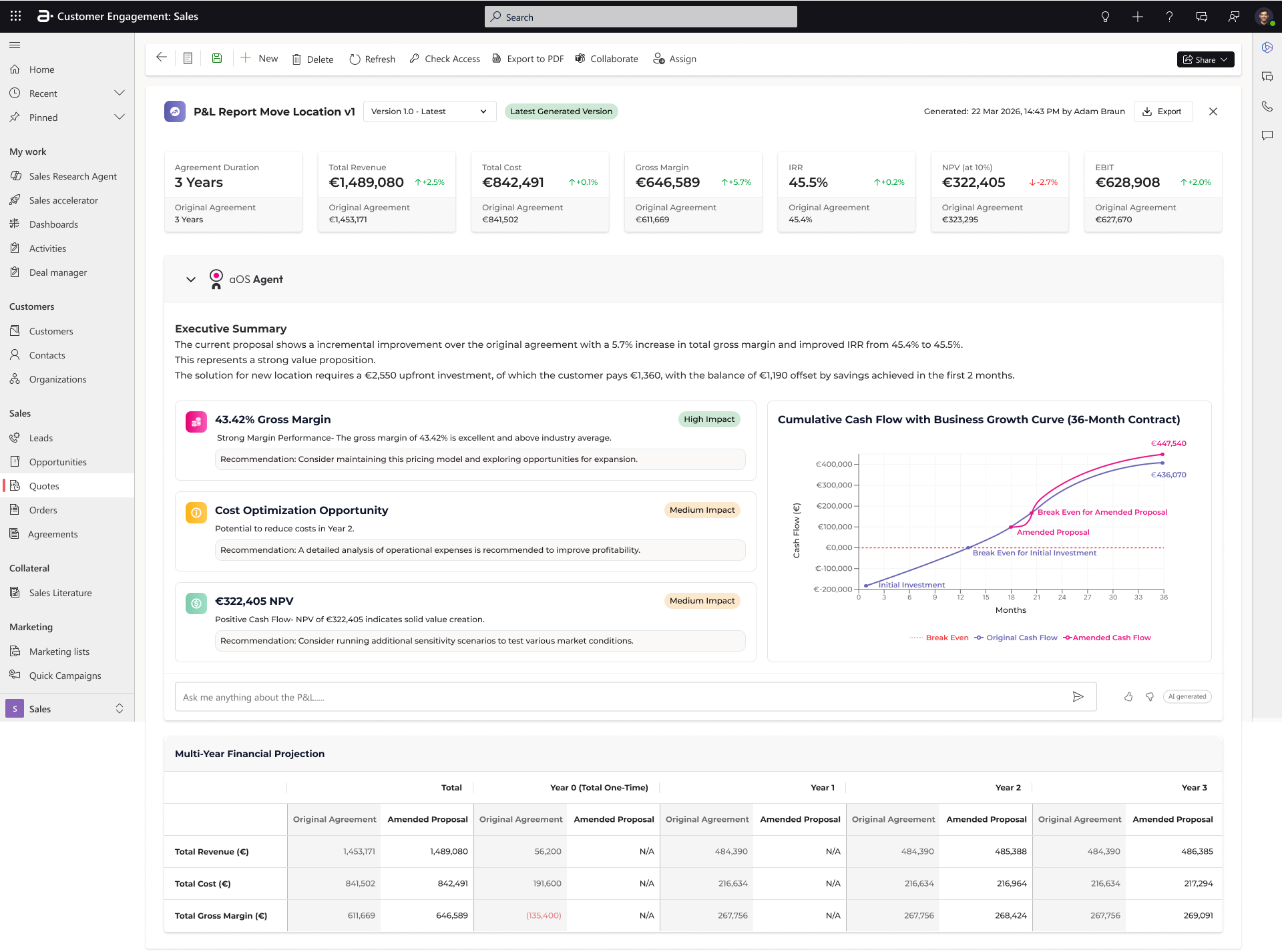
The same data - reorganized around decisions. KPI bar, AI summary, version tags, simulation columns.
The redesigned report has three structural layers. A KPI header bar surfaces the four metrics a rep needs to clear approval - gross margin, NPV, IRR, and payback period - before the full table loads. The AI executive summary translates the numbers into plain language: not "GM: 42%" but "this deal is above the 40% threshold for this agreement type, driven by the bandwidth upgrade on Site 3." The simulation columns let reps compare pricing scenarios side by side, with delta indicators showing which direction each metric moves.
Version management was a secondary design challenge. Reps and finance often worked off different versions of the same report, leading to mismatched approval contexts. I introduced explicit version states - Draft, Pending Approval, Approved - visible at the top of the report and locked once submitted. Approvers always see the exact version that was submitted, not an updated one.
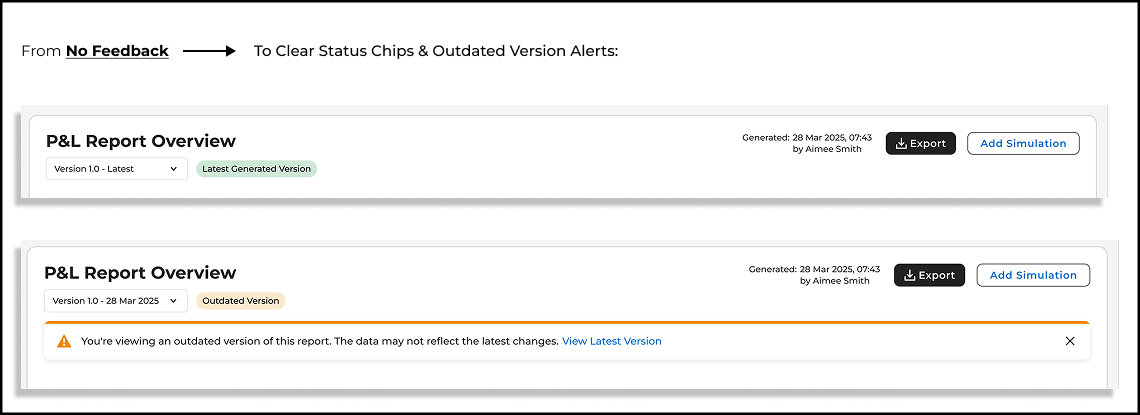
Version state and approval status visible at a glance. No more mismatched contexts between sales and finance.
Historically, pricing decisions were made by sales and then validated by finance - a sequential handoff that added days to the cycle and introduced revision loops. By embedding the P&L directly in the quote flow, reps can validate margin, NPV, and cash flow impact at the exact moment they are configuring offers. The report doesn't live in a separate system - it lives in the same screen as the offer configuration, updated in real time as parameters change.
The P&L embedded directly in the quote screen - AI summary, deal data, and configuration in a single view.
Users don't trust automation they can't observe. The Activity Log makes every agent-driven action visible in real time - not as a verbose audit trail, but as a curated summary of what was done and what the outcome was. When a rep sees "Serviceability Agent: Location Available," they know that step is complete and correct without verifying it themselves. Trust is built through this accumulated evidence of reliable execution.
The P&L report embedded in the quote flow changes the nature of a pricing decision. Instead of configuring first and finding out the margin impact days later, reps see financial consequences in real time. The AI summary distills what matters - "this deal is above threshold" or "simulation 2 improves gross margin by 8%" - so the report informs decisions rather than just recording them.
The agent's recommendation to add a Fixed Wireless Backup add-on surfaces contextually - at the moment the rep is reviewing the specific offer it applies to, not as a separate notification. The suggestion is concrete: specific product, specific benefit, specific price impact, actionable with one click. The difference between AI that feels useful and AI that feels intrusive is timing, specificity, and the ability to dismiss without friction.
The redesigned workflow collapsed a multi-system, multi-team process into a single agent-assisted screen. By eliminating the handoff between CPQ configuration and financial validation, reps could make informed pricing decisions without waiting for a finance review cycle. The Activity Log surfaced as a reference point reps used not just to track their own progress, but to communicate deal status to customers - a behavioral pattern that emerged in early testing and wasn't part of the original brief.
The P&L embedding was the right architectural call, but the AI analysis presentation needs refinement. The current version surfaces impact ratings like "High Impact" and "Medium Impact" without making the criteria explicit. In testing, reps asked what threshold defines "High" and the design didn't have an answer. In a next iteration, I'd replace verdicts with reasoned explanations: not "High Impact" but "exceeds the 40% gross margin threshold for this agreement type." The distinction matters significantly for how much reps trust and act on the output.