B2B Tech · 2026
Layline Tech
A proposed website redesign for an Odoo implementation partner - I designed the full UX/UI and built a working multi-page site as a personal project to demonstrate the upgrade.
Visit live site ↗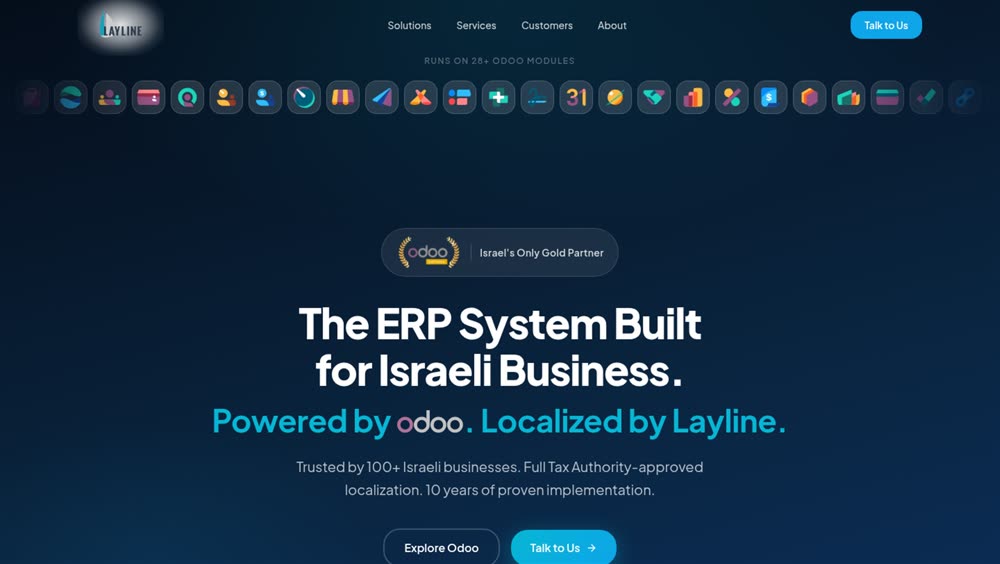
B2B Tech · 2026
A proposed website redesign for an Odoo implementation partner - I designed the full UX/UI and built a working multi-page site as a personal project to demonstrate the upgrade.
Visit live site ↗
Timeline
Personal project
Team
Solo
My Role
UX/UI Design & Full Development
Platform
Web - Multi-page marketing site
Layline Tech is an Israeli Odoo Gold Partner that helps businesses implement ERP systems. Their existing website didn't reflect the quality of their work or communicate their value proposition clearly. I took this on as an unsolicited personal project - a proposal to show what their web presence could look like.
I designed all the user flows and UI from scratch, then built a fully functional multi-page website using Next.js. The site covers their full story: homepage, about (with team and company values), services, solutions, customer stories, and contact.
B2B tech companies - especially implementation partners - often have websites that undersell them. The typical pattern is a template site with generic ERP language that could belong to any consultancy. Layline's differentiators (deep Israeli market expertise, Odoo Gold Partner status, 90%+ client retention) were buried or absent.
A company that transforms how businesses operate deserves a web presence that demonstrates the same level of craft.
I handled the full scope - from understanding the business to deploying the finished site:
Mapped out the site structure across six pages. Defined the content hierarchy for each page - what information a potential client needs to see, in what order, to move from "who are these people" to "I want to talk to them."
Designed every page and component: an interactive hero with floating Odoo module icons, trust indicators, customer video testimonials, a visual "sea voyage" company timeline, team profiles, service cards, solution breakdowns, and CTAs tuned for B2B conversion.
Built the complete site with Next.js (App Router), Tailwind CSS, and Framer Motion. Implemented smooth animations, responsive layouts, interactive components, and an Odoo Gold Partner badge with the official visual identity. Used Claude Code as my development partner throughout.
Deployed to Netlify with static export for fast global delivery.
The homepage hero features floating Odoo module icons that respond to mouse movement. This immediately communicates "Odoo expertise" without a single word of copy - and gives the page a dynamic feel that separates it from template B2B sites.
Instead of static quote cards, the site features embedded customer video testimonials. A real person speaking about their experience carries more trust than a formatted quote with a headshot - especially for high-consideration B2B purchases.
The About page tells the company story through a visual timeline styled as a sea voyage - a nod to the company name (Layline is a sailing term). This transforms a standard "our history" section into something memorable and brand-aligned.
The site spans six pages, each designed for a specific visitor intent:
Hero with interactive Odoo icons, trust bar, product video, module teasers, platform overview, "why Layline" value props, customer logos, testimonial videos, implementation process, and CTA.
Company story via sea-voyage timeline, team profiles with LinkedIn links, and core values.
Implementation, customization, training, and support offerings - structured to answer "what exactly will you do for us."
Industry-specific use cases showing how Odoo solves real problems for different business types.
Logo grid and success stories - social proof for the evaluation stage.
Clean contact form with clear next-step expectations.
Next.js (App Router) · Tailwind CSS · Framer Motion · TypeScript · Lucide Icons · Netlify. Static export with no backend - all content is component-driven, making it easy to hand off to a development team for integration with a CMS if the client adopts the design.
As an unsolicited proposal, the content is based on publicly available information and reasonable assumptions. If this were a client engagement, I'd start with stakeholder interviews and analytics from the existing site to validate which pages actually matter to their buyers. The "Solutions" page in particular would benefit from real customer journey data - right now it's structured by industry, but the actual decision path might be organized differently in their prospects' minds.